
Kitchen Fire Suppression

Class K Fire Extinguishers for Commercial Kitchens

Class K fire extinguishers discharge specialized potassium acetate wet chemical agents designed to smother high-temperature cooking oil and grease fires. Commercial kitchens that cook with vegetable or animal oils and fats must keep a tagged Class K unit within 30 feet of the cooking equipment under NFPA 10 and the California Fire Code.

A Class K fire extinguisher is the portable wet chemical extinguisher listed for cooking oil and grease fires. If your kitchen cooks with vegetable or animal oils and fats, NFPA 10 and the California Fire Code require one within 30 feet of the cooking equipment, as the backup to your hood suppression system. SOS Fire Services supplies, mounts and tags Class K units, adds the required placard, and recharges them after use across Los Angeles, Orange, Ventura and San Bernardino counties.

Compliance & Technical Summary for Commercial Kitchen Owners

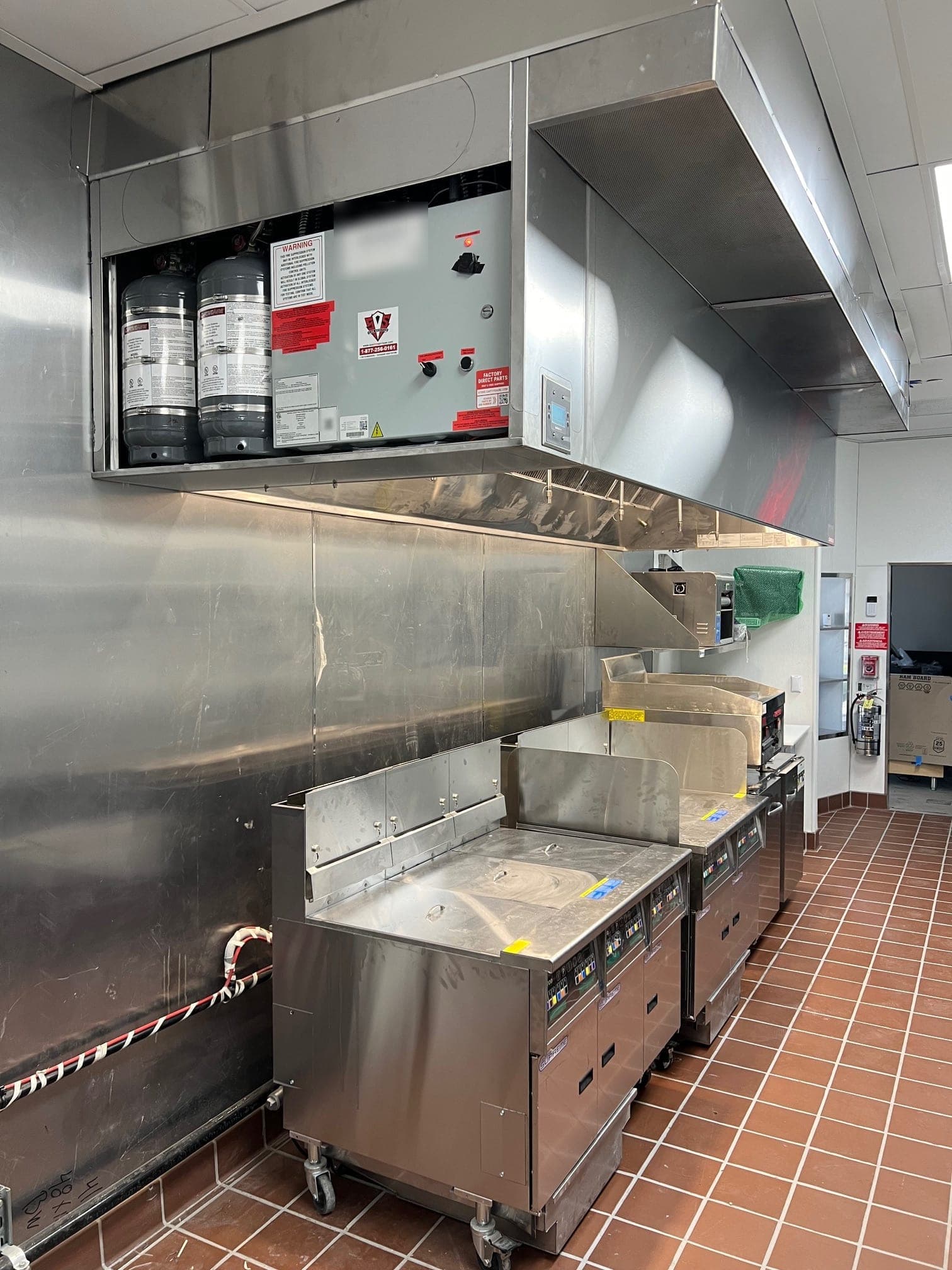
Class K extinguishers serve as the required manual backup to automatic hood suppression systems. When deep fryers, griddles, or wok lines ignite, wet chemical agents create a thick foam blanket through saponification, sealing off oxygen and cooling cooking oil below its auto-ignition point.

Class K Requirements at a Glance

The rules a fire inspector checks, with where each one comes from.

Class K Requirements at a Glance
RuleWhen it is requiredRequirementAny commercial cooking that uses vegetable or animal oils and fatsSourceNFPA 10; California Fire Code 906.4
RuleDistanceRequirementWithin 30 feet of travel from the cooking equipmentSourceNFPA 10; OCFA Guideline D-02
RuleDeep fat fryersRequirementOne 1.5-gallon (6 L) Class K for up to four fryers holding up to 80 lb of oil each; one more for each further group of fourSourceCalifornia Fire Code 906.4.2
RuleFryers over 6 sq ftRequirementClass K protection per the extinguisher manufacturer's guidanceSourceCalifornia Fire Code 906.4.2
RulePlacardRequirementA sign near the extinguisher: "Fire Protection System Shall Be Activated Prior To Using The Fire Extinguisher."SourceNFPA 10; OCFA Guideline D-02
RuleMountingRequirementTop no higher than 5 feet (units up to 40 lb); at least 4 inches off the floorSourceCalifornia Title 19 §567.6
RuleMonthlyRequirementA quick visual check by your staffSourceNFPA 10
RuleEvery 12 monthsRequirementMaintenance and a new tag from a State Fire Marshal licensed companySourceCalifornia Title 19 §575
RuleEvery 5 yearsRequirementHydrostatic test, with internal maintenance at the same timeSourceNFPA 10; California Title 19 §575.16
RuleAfter any useRequirementRecharged before it goes back on the wallSourceNFPA 10; California Title 19

Your fire authority can ask for more. See fire authority rules by county.

Regulatory Requirements: NFPA 10 & California Title 19

Maximum Travel Distance: Mounted within 30 feet of travel distance from cooking equipment.
Required Signage: Placed beside clear hazard instruction placards warning staff to actuate automatic hood suppression prior to utilizing manual Class K extinguishers.
Annual Tagging: Inspected, serviced, and sealed with a California service tag from a State Fire Marshal licensed company every 12 months.
Hydrostatic Testing Cycle: Hydrostatic testing every 5 years, with internal maintenance at the same time (California Title 19 §575.16).

Do You Still Need a Class K If You Have a Hood System?

Yes. The hood system and the Class K do different jobs, and inspectors check both.

  1. The hood system comes first.

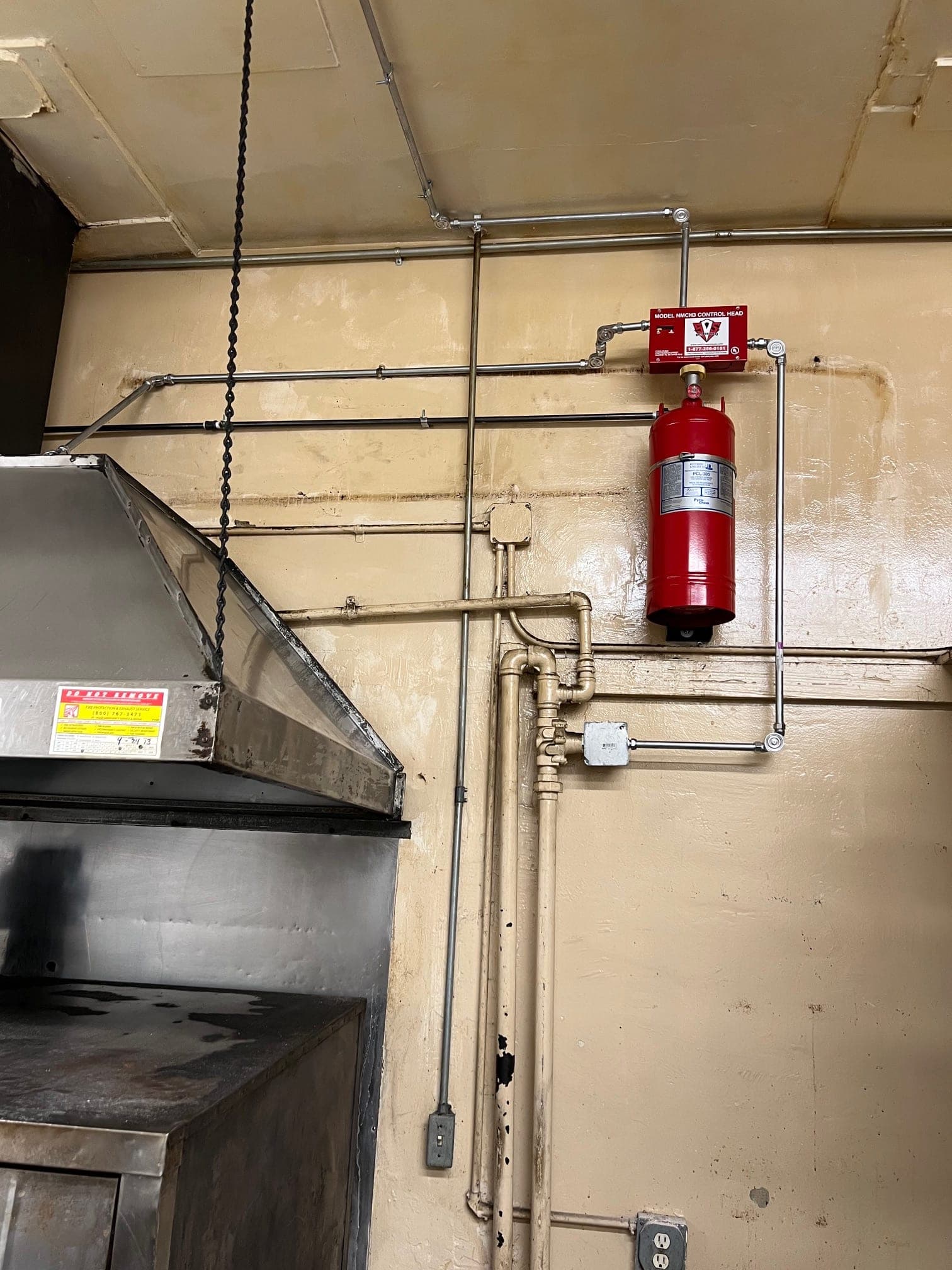
    It protects the appliances, hood and duct, and shuts off the gas or power to the cooking line when it fires. See Semi-Annual Inspection.

  2. The Class K is the backup.

    It is for a fire the system did not reach, or a flare-up after the system has fired.

  3. The placard says so.

    Staff pull the manual station first, then use the Class K. That order is why the placard hangs next to the extinguisher. We train your staff on it.

    Fire Protection System Shall Be Activated Prior To Using The Fire Extinguisher.

Who does what in a commercial kitchen

Who does what in a commercial kitchen
JobClass K extinguisherBackup on the cooking lineABC extinguisherPaper, wood and electrical fires elsewhere in the buildingHood suppression systemAutomatic protection over the cooking appliances
WhereClass K extinguisherWithin 30 feet of the cooking equipmentABC extinguisherAlong exits and corridorsHood suppression systemIn the hood and duct, with a pull station on the way out
ServiceClass K extinguisherMonthly check, annual tag, 5-year hydroABC extinguisherMonthly check, annual tag, 6-year maintenance, 12-year hydroHood suppression systemEvery six months
PageClass K extinguisherThis pageABC extinguisherFire Extinguisher ServicesHood suppression systemSemi-Annual Inspection

Why one extinguisher can't cover every class: see Fire Extinguisher Classes (A, B, C, D and K).

Class K Inspection & Service Checklist

Visual Inspection: Verification of pressure gauge green zone alignment, pull pin seal integrity, and nozzle obstruction clearance.
Weight & Fluid Verification: Checking solution levels and cylinder weight per manufacturer specifications.
Hose & Discharge Nozzle Check: Inspecting the hose and discharge wand for cracking or blockage.
State Fire Marshal Tagging: Applying annual compliance tags stamped with license credentials.

How Many Class K Extinguishers You Need, and Where

Fryers. One 1.5-gallon (6 L) Class K covers up to four fryers holding up to 80 lb of oil each. Add one for each further group of four. Fryers larger than 6 square feet follow the extinguisher maker's guidance.

Woks, griddles and ranges. The 30-foot rule applies wherever oils and fats are used, not only at fryers.

Wood-fired and solid-fuel ovens. These need their own extinguisher. Orange County, for example, accepts a 1.6-gallon Class K within 20 feet of a solid-fuel pile of up to 5 cubic feet.

Height and clearance. Hang it so the top is no higher than 5 feet and the bottom at least 4 inches off the floor.

On the way out. Inspectors want it along the normal path of travel, easy to reach, and they decide the final spot.

Ventura County. One Class K for each hood system.

See fire authority rules by county.

Class K Service Schedule

Class K Service Schedule
WhenEvery monthWhatGauge in the green, pin and seal in place, nothing blocking it, placard visibleWhoYour staffMore—
WhenEvery 12 monthsWhatMaintenance and a new tagWhoA State Fire Marshal licensed companyMoreInspection & Tagging
WhenEvery 5 yearsWhatHydrostatic test and internal maintenanceWhoA State Fire Marshal licensed companyMoreHydrostatic Testing
WhenAfter any useWhatRecharge before it goes back in serviceWhoA State Fire Marshal licensed companyMoreRecharge & Refill

Class K units are on a 5-year cycle. The 6-year maintenance and 12-year hydrostatic test apply to many dry chemical units, not to Class K.

We can tag your Class K on the same visit as your hood system's semi-annual inspection.

Common Fire Code Violations Avoided

Local fire marshals and health inspectors frequently issue citations for missing Class K units, expired annual tags, blocked access corridors, or substituting standard ABC dry chemical extinguishers on cooking lines. Using dry chemical on hot cooking grease can cause violent re-ignition or splatter burns. See Fire Code Violations.

Class K Sales, Installation & Recharge Services

SOS Fire Services supplies new 6-Liter and 2.5-Gallon stainless steel Class K extinguishers, wall brackets, protective cabinets, and recharge after any use, in our shop with a loaner left in its place. Contact our Northridge headquarters at (877) 256-0161 for rapid service.

New 6 L and 2.5-gallon Class K units from Buckeye, Ansul, Pyro-Chem and Badger
Wall mounting at the right height, with the placard
Annual maintenance and tag
Recharge in our shop, with a Class K loaner on your wall
5-year hydrostatic test and internal maintenance
Correcting a Class K write-up from your fire inspector
Staff training on the hood-first order

Who Can Service a Class K in California

California Title 19 says servicing a portable extinguisher, including maintenance, recharging and hydrostatic testing, must be done by a company licensed by the State Fire Marshal. The tag on your Class K shows who serviced it and their license. See how to read a fire extinguisher tag.

California State Fire Marshal licensed (E2390) · CSLB C-16 #976500

Frequently Asked Questions

How many Class K extinguishers does a restaurant need?

At least one within 30 feet of the cooking equipment. For deep fat fryers, one 1.5-gallon (6 L) Class K covers up to four fryers holding up to 80 lb of oil each; add one for each further group of four. Larger fryers follow the extinguisher manufacturer's guidance. A solid-fuel cooking appliance with a firebox of 5 cubic feet or less needs one 2.5-gallon or two 1.5-gallon Class K extinguishers (California Fire Code §906.4).

Do food trucks need the same kind of system?

Food trucks that cook with oil or grease need a Class K extinguisher, and a hood suppression system on board has to be serviced at least every six months, like any kitchen system in California. Requirements for trucks vary by fire department, so we confirm them for each truck.

Do I need a Class K extinguisher if my kitchen has a hood suppression system?

Yes. The hood system is the main protection, and the Class K is the required backup within 30 feet of the cooking equipment. A placard next to it tells staff to activate the hood system first.

Can I use an ABC extinguisher on a fryer fire instead?

No. ABC powder can knock the flames down without cooling the oil, so the fire can flare up again, and it does not meet the Class K requirement. Keep ABC units for the rest of the building.

What does the Class K placard say?

"Fire Protection System Shall Be Activated Prior To Using The Fire Extinguisher." It hangs near the extinguisher so staff pull the hood system first.

Verified reviews

What Customers Say About This Service

Overall customer rating: 5.0/5 from 151 Google and Yelp reviews.

5 star review
After weeks of calling different companies and researching about fire suppression systems, I finally found Zohar at SOS fire services. He takes pride in his work and wants to do a clean job. He gave me the best price for my food truck and was very knowledgeable about his craft. He told what I needed to be compliant and that I needed a class k extinguisher… read more K class extinguisher Nozzles over fryer Manual pull
Read more of Haroot G.'s review
Haroot G.Jul 18, 2019
5 star review
I own a restaurant in Buena Park, and on Saturday morning, my Ansul system would not turn the gas on or off. I called several companies looking for guidance/help and SOS was the only one courteous enough to help me troubleshoot the problem. Maureen not only was sympathetic to my plight, which de-escalated the stressful situation, she also walked me through the steps to get my gas up and running for business. My original fire company just blew me off, so now I look forward to using SOS for all my fire suppression needs. Taking the time to help shows the integrity of their service. Bravo!
Read more of Lara Hanneman's review
Lara HannemanSep 8, 2026
5 star review
We have a restaurant in Santa Monica and had a small fire incident from one of our fryers that activated our fire suppression system. We called SOS Fire Services and they responded very quickly. They took care of everything, got the system serviced and back up and running, and helped us avoid losing business and revenue. The technician was professional, knowledgeable, and explained everything clearly. We really appreciated the fast response, especially during a stressful situation. I Highly recommend SOS Fire Services for any restaurant fire suppression .
Read more of Leslie Bitton Sirota's review
Leslie Bitton SirotaAug 30, 2026
Show 3 more reviews
5 star review
Great partners for our restaurant. Always transparent and honest. We are so glad we switched over. Truly thankful!
Chris PFeb 12, 2024
5 star review
Very satisfied with SOS Fire Services, I have been using their services at Grill Kabob restaurant in Santa Clarita for years. Mike and Brandon did an excellent job explaining the details and charges, and they made sure that everything was done properly.
Read more of Ara K.'s review
Ara K.Oct 9, 2023
5 star review
Definitely recommended! The customer service is super nice and understanding. And my fire service technician Brandon is just wonderful! I'm a new owner for a previous operating business, and he explained to me all the details, the logistics while patiently checking and updating my system. 10/10 experience!
Read more of Qi G.'s review
Qi G.Sep 27, 2023

Read all customer reviews

Our work

Recent Kitchen Fire Suppression Projects

Jobs we completed for this service. Every card names the city where the work was done.

See all our work →

Where We Provide This Service

We provide on-site service in Los Angeles, Orange, Ventura and San Bernardino counties. Share your service address and equipment details so we can confirm the work and coordinate a visit. Emergency dispatch is arranged by phone.

References on this page to LAFD or the Los Angeles Municipal Code apply to the City of Los Angeles jurisdiction. For other service addresses, we confirm the relevant fire authority and its requirements.

Request a Quote

Get Class K Extinguishers Installed

Cooking with oils or fats? You need a Class K unit within 30 feet of the cooking line. We supply, mount and tag them.

  • Response within 2 hours
  • We work around your kitchen's hours
  • State Fire Marshal licensed technicians

Free on-site evaluation for most jobs. We'll tell you before any charge.

By submitting, you agree to our Privacy Policy. We don't sell your information. Details you send us are used to contact you about your enquiry.