You entered your address on a fire hazard map and it came back Moderate, High or Very High. The two questions we hear most from property owners and facility managers after that are:
- "My building is in a High Fire Zone. Do I need more fire extinguishers or system upgrades to stay compliant?"
- "My insurance company wants enhanced fire protection because of our hazard zone. What do I need to add?"
The short answer to the first: no code we know of requires a business to add fire extinguishers because of its hazard zone. Extinguisher requirements come from your occupancy and the hazards inside the building. The zone does change other things, mainly construction rules, brush clearance and real-estate disclosure. This guide explains what changed on the maps, what the zone actually triggers, and how to check your address.
What a Fire Hazard Severity Zone is
A Fire Hazard Severity Zone (FHSZ) is a classification set by the Office of the State Fire Marshal (CAL FIRE) under the Public Resources Code, Title 14 of the California Code of Regulations and the Government Code. Every zoned area is Moderate, High or Very High.
The maps measure hazard, not risk. Hazard is based on the physical conditions that make a fire likely and shape how it would behave over 30 to 50 years: fire history, vegetation, predicted flame length, blowing embers, terrain and typical fire weather. The maps do not account for mitigation such as a hardened building or cleared brush, so clearing vegetation will not move your property to a lower zone.
The 2024 and 2025 map updates
California is split into two kinds of areas, and each has its own map:
- State Responsibility Area (SRA): land where the state is responsible for wildfire protection, mostly unincorporated wildland and foothills. The current SRA map took effect on April 1, 2024.
- Local Responsibility Area (LRA): cities and other areas protected by a local fire agency. The State Fire Marshal released new LRA recommendations in four phases between February 10 and March 24, 2025. The old LRA maps showed only Very High zones; the new ones show Moderate, High and Very High.
In an LRA, the state map is a recommendation. Each city or county must adopt the zones by ordinance within 120 days. It may add areas or raise a zone, but it may never lower one. That is why the State Fire Marshal tells LRA property owners to confirm their zone with their local jurisdiction.
Where the four Southern California counties stand:
- San Bernardino County: the Board of Supervisors adopted the LRA zones with Ordinance No. 4489 on June 10, 2025.
- Orange County (unincorporated areas): adopted with Ordinance No. 25-015 on August 26, 2025. Cities with their own fire departments adopt separately.
- Ventura County Fire Protection District: the new LRA zones took effect July 1, 2025. Where a parcel falls in two zones, the higher zone applies to the whole parcel.
- Los Angeles County Fire District: the fire district asked the Board of Supervisors on July 22, 2025 to adopt the new zones by ordinance. Check your parcel with the LA County Fire Department.
- City of Los Angeles: the city must adopt the recommended map by ordinance, and we could not confirm that it has. Check the zone for a City of LA address with the Los Angeles Fire Department.
How to check your address
- Use our Fire Hazard Zone Checker. It reads CAL FIRE's current maps: the SRA map in effect since April 2024 and the LRA recommendations from 2025. It tells you whether the address is in an SRA or LRA and which zone applies.
- For an LRA result, confirm with your city or county. The adopted local map controls.
- For the official state view, use the map viewers on the State Fire Marshal's Fire Hazard Severity Zones page.
What the zone changes for a business
| Moderate (LRA) | High (LRA) | Very High (LRA) | Any SRA zone | |
|---|---|---|---|---|
Wildfire construction code for new buildings, additions and exterior work | Moderate (LRA) Not by state law | High (LRA) Yes | Very High (LRA) Yes | Any SRA zone Yes |
State defensible-space rule (100 ft) | Moderate (LRA) No | High (LRA) No | Very High (LRA) Yes, occupied structures | Any SRA zone Yes |
Seller must disclose the zone | Moderate (LRA) No | High (LRA) No | Very High (LRA) Yes | Any SRA zone Yes, under a separate SRA rule |
Extra fire extinguishers | Moderate (LRA) No | High (LRA) No | Very High (LRA) No | Any SRA zone No |
Construction. Since January 1, 2026, California's wildfire construction rules sit in the 2025 California Wildland-Urban Interface Code (Title 24, Part 7), and the State Fire Marshal has made it apply in both High and Very High LRA zones. It affects new buildings, additions and exterior alterations, so talk to your architect or building department before a project.
Defensible space. In a Very High zone adopted by your local agency, anyone who owns, leases or operates an occupied structure must keep 100 feet of defensible space around it. The law also calls for a 5-foot ember-resistant zone right next to buildings, but that part depends on state regulations that were not in effect when we wrote this. Check with your fire department before relying on either way.
Disclosure. A seller of property in a Very High zone must disclose that fact to the buyer.
Does a fire zone mean you need more extinguishers?
No. The fire code sets where extinguishers go by occupancy type and by specific hazards such as commercial cooking, flammable liquids and buildings under construction. Your hazard zone is not on that list. So if your extinguishers were up to code before the new map, the map did not make them out of date.
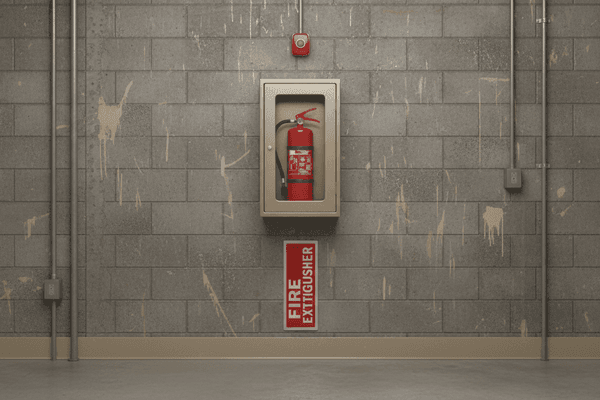
That said, a Very High zone is a reason to think about the outside of the building. Our technicians strongly recommend weather-resistant exterior fire extinguishers near high-risk outer areas, such as loading docks, equipment staging areas and secondary exits, so a small fire started by embers can be put out early, before it reaches the building. This is our recommendation, not a code requirement. An extinguisher is for a small fire you can safely reach; if a wildfire is approaching, follow your fire department's evacuation orders. Outdoor units are often mounted in a cabinet, and a closed cabinet exposed to high temperatures has its own requirements, so ask us before installing one in direct sun. See our extinguisher cabinets.
One activity rule does involve extinguishers. In the City of Los Angeles's Very High zone, LAFD requires an approved fire extinguisher, or a pressurized garden hose with a nozzle, within 10 feet of brush clearance work. Clearance is not allowed on red flag days, and metal cutting blades must be non-sparking. Owners in that zone must keep vegetation cleared within 200 feet of structures and 10 feet of roads and combustible fences.
Restaurants and commercial kitchens
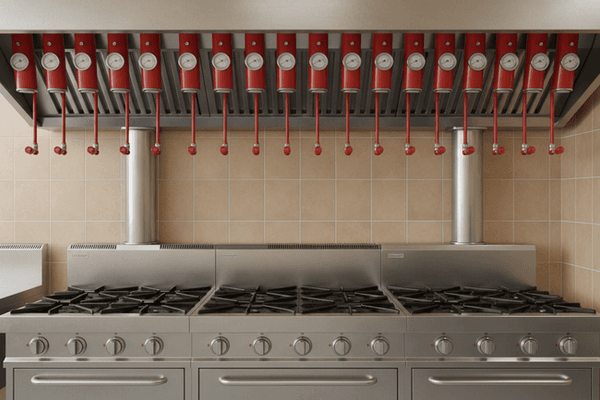
The zone does not change your kitchen fire suppression system. In our experience, fire inspectors reviewing commercial kitchen systems focus on hood and appliance coverage, the appliance layout, fuel shutoffs and Class K extinguisher placement, and the hazard zone has not changed what they require. Keep your semi-annual kitchen system inspection and Class K extinguishers current, as you would anywhere else.
What about insurance?
The California Department of Insurance has said plainly that the CAL FIRE hazard maps "are not used for insurance rates or underwriting decisions." Insurers use their own wildfire models. If your insurer asks for added fire protection, ask for the exact list in writing. Extinguishers, cabinets and inspection records are things we can supply and document. Vegetation work, roofing and sprinklers are not; use a specialist for those.
Frequently asked questions
Is the fire hazard map the same as my wildfire risk? No. The map shows hazard from terrain, vegetation and weather, without counting what you have done to protect the property.
Can my city lower my zone? No. A city or county may add areas or raise a zone, but it cannot lower what the State Fire Marshal recommended.
My building is in a High zone. Do I need new extinguishers? Not because of the zone. You need the extinguishers your occupancy and hazards call for, inspected and tagged every year. Our annual inspection and tagging covers that.
Which map applies to a property inside a city? The map your city or county adopts by ordinance. The state map is the recommendation it starts from.
Check your extinguishers, not just your zone
Make sure your extinguishers meet code and are ready to use. Schedule a commercial fire extinguisher inspection or speak with one of our licensed technicians today.