Most restaurant owners see only two parts of their fire suppression system: a red pull station by the door and a row of small nozzles under the hood. Between them sits a mechanical system that can find a fire, shut off the cook line and put the fire out without needing building power or anyone pressing a button. This article explains how the ANSUL R-102 does it.
What's on your wall
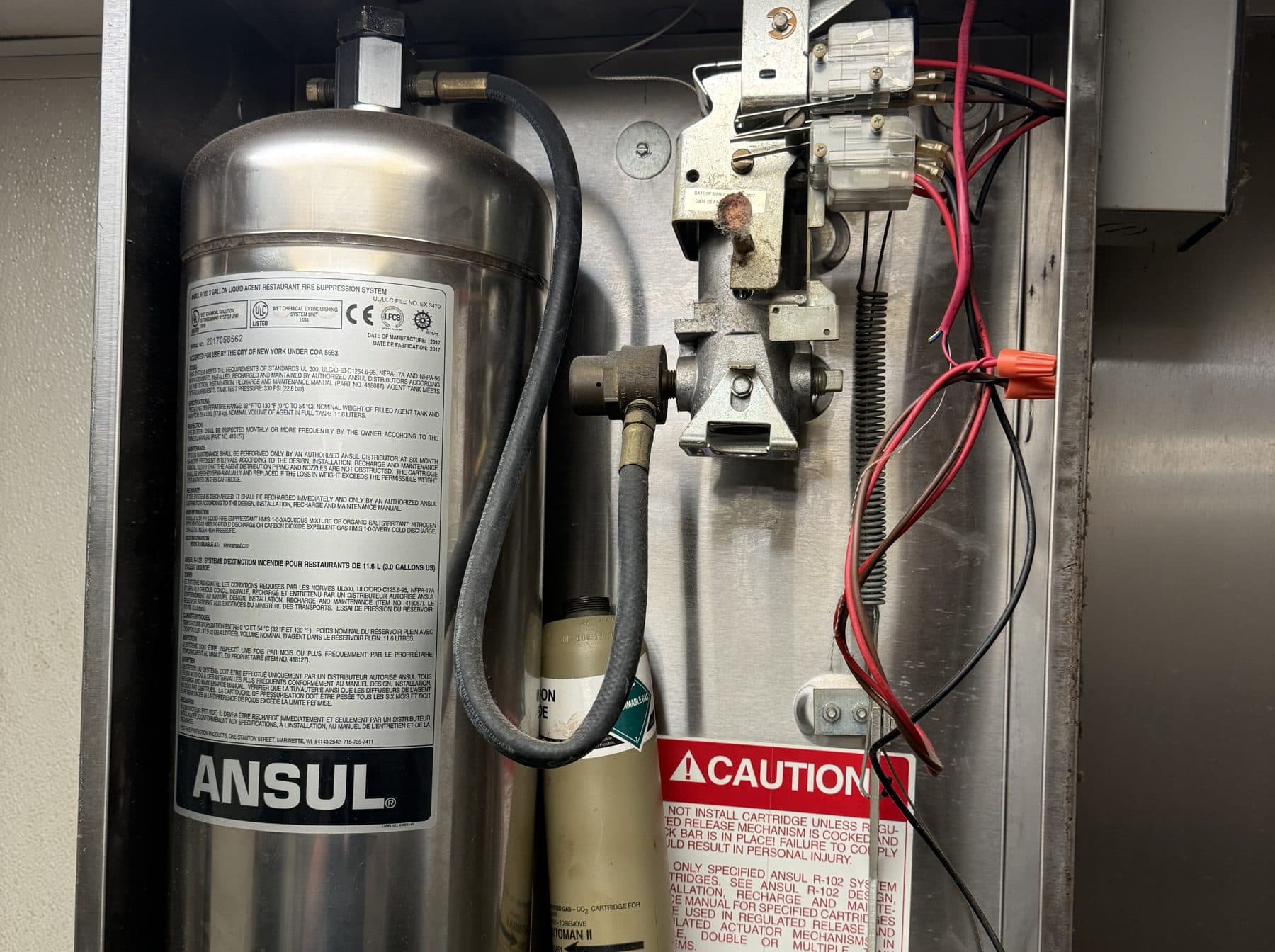
The heart of an R-102 is a stainless steel box, usually mounted on a wall near the hood. Inside it are the AUTOMAN regulated release and a tank of wet chemical agent. Larger kitchens have extra tanks connected to the same release. From the box run three things:
- a detection line: a thin steel cable in conduit that runs over the hood to heat detectors above the appliances,
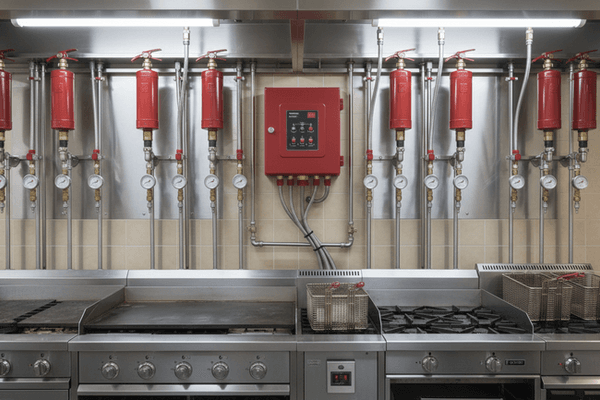
- distribution piping to nozzles above each appliance, in the hood plenum and in the duct,
- a cable to the manual pull station and, on most systems, to a gas valve on the line feeding the appliances.
Our ANSUL System Service page describes each component. Here's how they work together.
What happens, step by step
1. Heat melts a fusible link
Each detector over the cook line holds a fusible link, a small alloy link that separates when the temperature passes its rating. Links come in ratings from 165 °F to 500 °F. The technician picks each one by the highest normal temperature at that spot, so a link near a charbroiler usually needs a higher rating than one in a cooler spot.
2. The cable goes slack and the release fires
All the detectors hang on one stainless steel cable, held under tension at the release. A single line can carry up to 15 detectors. When any one link separates, the cable goes slack, and the trip lever fires the release. It's purely mechanical: nothing in this chain needs building power.
3. A gas cartridge pressurizes the tank
The release punctures a small cartridge of nitrogen or carbon dioxide. A regulator, fixed at 110 psi, feeds that gas into the agent tank. A bursting disc in the tank keeps the agent from creeping up the pipe when temperatures swing. If the system has more than one tank, they all discharge together.
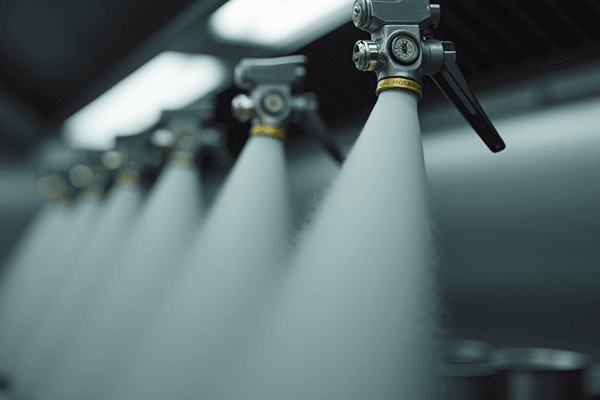
4. Agent sprays from every nozzle at once
The agent flows through fixed piping and out the nozzles at a set rate, onto the appliances, into the plenum behind the filters and up the duct. Each nozzle tip is built for one job, such as a fryer, a griddle or the duct, and is stamped with a flow number. Blow-off caps keep grease out of the tips until the moment of discharge.
5. Fuel and heat shut off
At the same moment, the system cuts the energy to the cooking line. With a mechanical gas valve, the most common setup on the systems we install, the release closes it directly. With an electric gas valve, a switch in the release cuts the power that holds it open, and it stays shut until someone presses a manual reset relay. Electrical switches shut off electric appliances, and where the building has a fire alarm, another switch can trigger it. On our installs, our own technician connects that switch to the building alarm. The California Fire Code requires this shutoff to be automatic and the reset to be manual.
Two things are easy to get backwards. The hood exhaust fan normally keeps running: ANSUL says it "should be left on" because its draft helps carry the agent through the duct and then cools it. The make-up air that blows in through the hood is what shuts down.
6. The agent turns the grease into foam
The agent cools the burning grease and reacts with it (a process called saponification) to form a layer of soap-like foam on top. The foam seals in the flammable vapors, which is what keeps a fryer from re-igniting once the flames are out.
The manual pull station
The pull station does steps 2 through 6 by hand. Pulling the ring tugs a cable that fires the same release. California puts it at or near an exit from the kitchen, 10 to 20 feet from the exhaust system and 42 to 48 inches above the floor, so someone can fire the system on the way out.
The agent: ANSULEX Low pH
ANSULEX is a potassium-based solution of organic salts, with a pH of 7.7 to 8.7. Despite the "Low pH" name, it's mildly alkaline, not acidic. It has a 12-year storage life, and the tank holding it gets a hydrostatic test every 12 years. The system and its tanks have to sit where the temperature stays between 32 °F and 130 °F.
For what to do with the agent after a discharge, see our guide to what to do when your Ansul system goes off.
How coverage is designed (and why moving a fryer matters)
An R-102 isn't a sprinkler that wets everything. It's designed around your exact cook line, in one of two ways:
- Appliance-specific: each nozzle is aimed at one appliance, at a set height and aiming point.
- Overlapping: nozzles are spaced evenly so a group of appliances, or the whole hood, gets continuous coverage.
Either way, the limits on what can be protected and how the pipes and nozzles are laid out are written into ANSUL's manual, which is part of the system's UL listing. That's why the cook line can't change freely. Swapping a griddle for a fryer, or sliding a range a few feet, can leave an appliance under the wrong nozzle or none. California requires the system to be brought back into compliance when the cooking media, the position or the equipment itself changes. In Orange County, approved nozzles can't be moved without new plans and an inspection. Appliances on casters can use a listed hose with a restraining cable, so they can be pulled out for cleaning without losing protection.
Call your servicer before the new equipment arrives, not after. Our Nozzle Service covers repositioning after a kitchen change.
Where the codes come in
- UL 300 is the fire test. Each appliance is loaded with grease and the fire is left to reach full intensity before the system fires. The R-102 is listed to it. California requires wet chemical systems to comply with UL 300, existing ones included. Our post Is UL-300 Mandatory in California? explains the requirement.
- Service: California requires these systems to be serviced at least every six months and right after any discharge, by a CSLB C-16 or State Fire Marshal "A" licensee. See our Semi-Annual Inspection page for what that visit covers.
Why you still need a Class K extinguisher
The R-102 protects the appliances under the hood. A Class K extinguisher covers what it doesn't: a fire outside the protected area, or a re-flash after the system has fired. ANSUL's design requires one wherever cooking oils and fats are used. California requires one within 30 feet of the hazard, with a placard that says to activate the fire protection system first. See Class K Extinguishers.
What your staff can check, and what they can't
ANSUL asks owners to look the system over at least monthly: nozzle caps on, pull station clear and untouched, seals on the release intact. The Ansul page lists these checks. Everything past looking is a technician's job: links, cartridges, the release, gas valves and the agent. The detailed manual is released only to trained, qualified people, and California law limits the work to licensed contractors.
Frequently asked questions
Does an Ansul R-102 work during a power outage?
Yes. The standard release is spring-loaded and mechanical, and it fires from the detection cable or the pull station. An electric gas valve closes when the power fails and stays closed until it's manually reset.
What temperature sets off an Ansul system?
It depends on the link. Ratings run from 165 °F to 500 °F, and each link is chosen for the normal temperature where it hangs.
Does the Ansul system shut off the exhaust fan?
Normally no. The exhaust fan keeps running to help move the agent and cool the duct; the make-up air built into the hood shuts down.
Is the Ansul system the same as the hood?
No. The hood captures grease vapor and smoke. The R-102 is a separate fire suppression system installed in and around it.
R-102 service from SOS Fire Services
SOS Fire Services is an Authorized ANSUL Distributor & Dealer, licensed under CSLB C-16 #976500. Our technicians are factory-trained on the R-102 and AUTOMAN release, and we install, inspect, recharge and repair R-102 systems across Los Angeles, Orange, Ventura and San Bernardino counties. Recent examples: a dual-hood R-102 installation in Newbury Park and a corroded pull station replaced in Tarzana.
Call (877) 256-0161 or book through our ANSUL System Service page.
Sources
- R-102 Restaurant Fire Suppression System: Design, Installation, Recharge and Maintenance Manual (ANSUL, Part No. 418087-12)
- R-102 Restaurant Fire Suppression System Data Sheet (Johnson Controls, 2024)
- R-102 Restaurant Fire Suppression System Owner's Guide (ANSUL, Part No. 418127)
- California Fire Code 2025, Chapter 9: Fire Protection and Life Safety Systems
- Cal. Code Regs. tit. 19, § 904: Inspection, testing and maintenance frequencies
- Cal. Code Regs. tit. 19, § 905: Licensing
- Cal. Code Regs. tit. 19, § 573: Fire extinguisher requirements
- Orange County Fire Authority Guideline D-02: Fire Extinguishing Systems for Commercial Cooking Operations (2026)